The Gap Fintech Left Behind
By AfricInvest
Africa's fintech revolution, which began in 2007 with the launch of M-Pesa in Kenya, was driven by one major gap: Most Africans had no bank account. That gap has now narrowed. At least six in ten Africans now have access to a bank or mobile money account. But fewer than two in ten have any form of health insurance.
This “protection gap” is wider than the financial inclusion gap that created a decade of fintech investment. Insurance penetration across the continent stands at just 2.8% (and below 1% excluding South Africa), against a global average of 6.5%. The African insurance market was worth $92.9 billion in 2024 and is projected to reach $160.9 billion by 2033.
____________________________________________________________________________
The Gap Is Wider, But The Rails Are Already Built
The early fintech players had to build distribution from scratch, which now benefits the insurtech ecosystem as two-thirds of Africans already have access to mobile payment methods. That gives insurtech companies a channel to collect premiums too small and too irregular for conventional distribution to handle profitably and allows them to embed cover into everyday transactions instead of building a distribution network of their own.
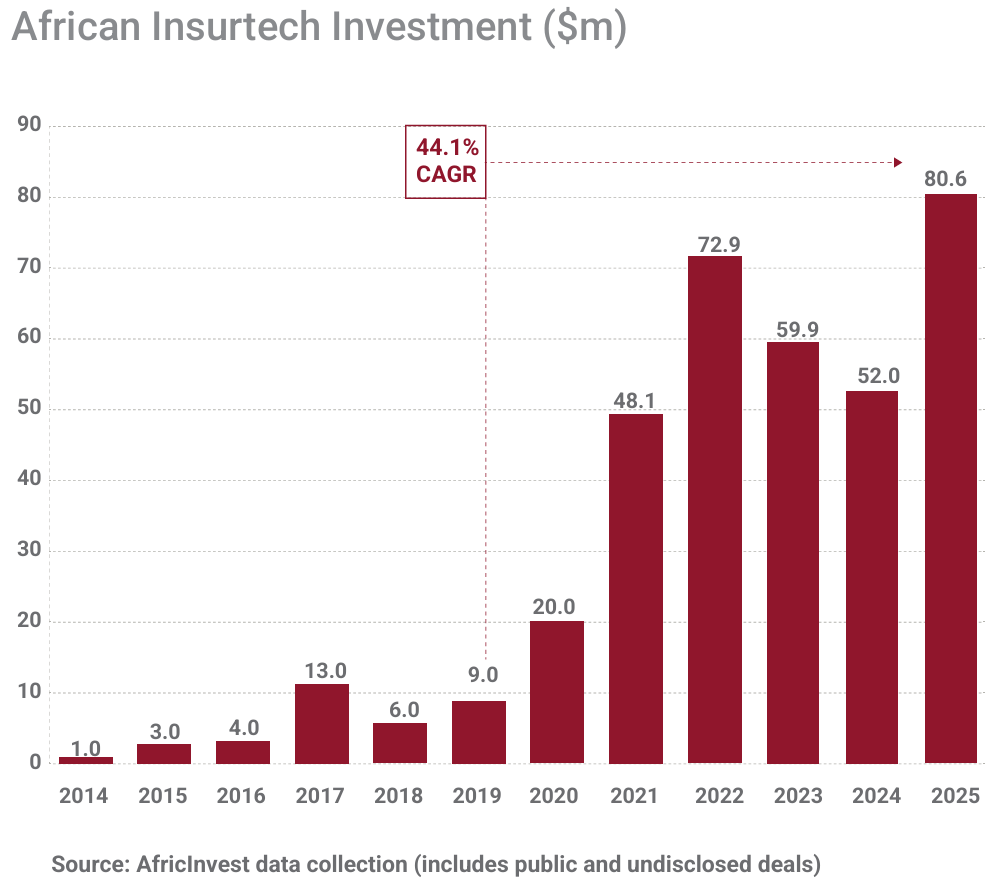
Investors have identified the opportunity, deploying more than $300 million into African insurtech over the past five years, with funding reaching a record $80.6 million in 2025. More telling than the total is its growing maturity. Series A and B rounds are now routine, and growth-stage investors such as General Atlantic, the IFC and BlueOrchard are among the participants. This is no longer a seed-stage experiment.
 ____________________________________________________________________________
Five Years Behind Asia, On A Shorter Road
The natural benchmark is India, whose insurtech ecosystem produced more than 150 startups raising $2.7 billion in cumulative funding. Its three unicorns – Policybazaar, Go Digit and Acko – now touch around 7-8% of India’s general insurance premium. While African markets trail India on VC activity and macro indicators by roughly five years, some factors specific to the continent could actually accelerate progress.
When Indian insurtech funding took off in 2014, the county’s internet penetration was 13.5%. African internet penetration was already at 36% when insurtech acceleration began in 2019. Moreover, seven in ten Africans are under 30, against just over half in India, creating an even more significant natural demand for digital products. Africa's insurance premium mix also leans towards shorter, modular non-life products, which are far easier to digitise than the long-term life policies that dominate in India.
While Indian unicorns achieved growth via both direct and embedded distribution, Southeast Asia’s winners focused heavily on the partner route. Pasarpolis, Qoala and Igloo all reached scale thanks to embedded B2B and B2B2C distribution, an approach that has also proved successful in Africa to reach low-income populations.
Africa can learn from Asia’s insurtech success stories, but already leads in areas these regions have barely developed. Credit-linked cover sits inside digital lending platforms, and health insurance regularly comes as an integrated offering bundled with telemedicine and wellness services. Telco partnerships such as MTN–Sanlam and Safaricom–Britam offer cheap and effective distribution channels.
____________________________________________________________________________
Where The Returns Are Likely To Materialise
For investors, the most scalable model is embedded distribution through partners that already own the customer relationship, like fintech, MFIs and telcos. It sidesteps the high acquisition costs and weak organic demand that make direct-to-consumer insurance a hard sell outside South Africa. Vertical specialists in health and agriculture and infrastructure providers that sell technology to insurers are credible alternatives.
Nonetheless, the constraints are real. Most African insurtech startups are still pre-profit, and 54 jurisdictions make cross-border expansion slow and costly. Local reinsurance capacity is thin, and demand for parametric products outstrips supply. Even so, Bolttech's acquisition of Kenya's mTek in December 2025 produced one of the sector's first confirmed exits. And similar to the insurtech evolution in Asia, maturing players such as Turaco and Pula are moving beyond distribution into underwriting their own products to increase margins.
Besides the Asian success stories, there is a local precedent for innovation turning mainstream. Equity Bank in Kenya and Capitec in South Africa both built their businesses by serving customers the established banks had ignored, then grew into two of the region's largest lenders by offering a simpler, cheaper service. African insurtech has the opportunity to replicate that story.
AfricInvest's full research report, African Insurtech Landscape 2026, is available here.
____________________________________________________________________________
About AfricInvest
AfricInvest is a leading pan-African multi-asset investment platform founded in 1994, specializing in private equity, venture capital, and private credit across North and Sub-Saharan Africa.
Learn more about AfricInvest at www.africinvest.com